Completion disputes
Contractor says the work is done, but it is not
Everything in the file has the same author
Before deciding whether anyone is lying, look at what you are actually holding. A signed change order. An invoice with a line reading final payment. A handful of photos sent on the day. An email saying the crew wrapped up Thursday. Each of those is a real document, and not one of them came from anywhere other than the party being paid.
That is not an accusation, and it is not sloppiness on anyone’s part. Field paperwork works this way in every trade, and federal construction contracting assumes it will. The standard clause FAR 52.246-12, Inspection of Construction requires the contractor to run its own inspection system, keep complete records of that inspection work, and produce them when the government asks. The party doing the work keeps the record of the work. Even the largest buyer in the country builds on that arrangement.
The cost only surfaces when somebody disagrees. A record written by one side restates that side’s position; it cannot settle a question about itself. So the useful question is not whether your contractor is honest. It is which parts of this file, if any, came from somewhere else.
What a file that looks like progress can be hiding
A contractor in Niagara County, New York advertised barns, garages and decks on Facebook and collected deposits from more than a dozen homeowners, running from a few thousand dollars to over thirty thousand. According to the New York Attorney General, the deposits were emptied within days through cash withdrawals and personal spending, while the customers got excuses that ran on for months and in some cases years: equipment trouble, illness, permits. He sometimes dropped off materials that could not be used, and sometimes produced invoices that were not real, so a file would look like a job under way. Construction never started. He pleaded guilty in March 2024 to grand larceny and a scheme to defraud, drew four to eight years in state prison, and left judgments totalling $453,058.
Be careful about what one prosecution shows. It is a single case rather than a frequency, and there is no trustworthy public figure for how often completion claims get contested. What it does illustrate is a mechanism. Where every document in a file was produced by the person being paid, a file that looks like progress and a file that is progress are indistinguishable from the outside. Those homeowners were not careless readers. They read exactly the evidence they had been handed.
No record stops that behaviour. What a dated capture at each address would plausibly have changed is the length of the argument, by turning “we will be back next week” into a question anyone could check on a Tuesday afternoon.
Walk it against the contract, not against your impression
Before writing to anybody, split two things that usually get argued as one. Incomplete work is scope nobody performed. Defective work is scope performed badly. In an email they read identically. They are checked in completely different ways, and mixing them is how a walkthrough turns into an exchange of opinions.
- Put the scope beside the payment claim, line by line. Not the summary paragraph: the itemised schedule each payment was drawn against. Any amount you cannot map back to a scope line is the first thing to raise, and it is a factual question rather than an accusation.
- Photograph what is missing, not what annoys you. A picture of an unfinished item, framed next to the line item claiming it was finished, carries the whole point in one shot. A picture of a room you are unhappy with carries a mood.
- Do the walk and the photographs on the same day. A walkthrough written up three weeks afterwards becomes your recollection of an afternoon, which puts your record in precisely the position you are objecting to in theirs.
- Ask what got closed up, and when. This is the question people skip, and it is the one that decides how much of the job can still be examined at all. More on it below.
- Define finished for whatever is left. “Finish the bathroom” settles nothing. “Tile trim run at the tub surround, cover plates fitted, door hung and latching” is a list either side can walk with you and sign off on the spot.
The work nobody can go back and look at
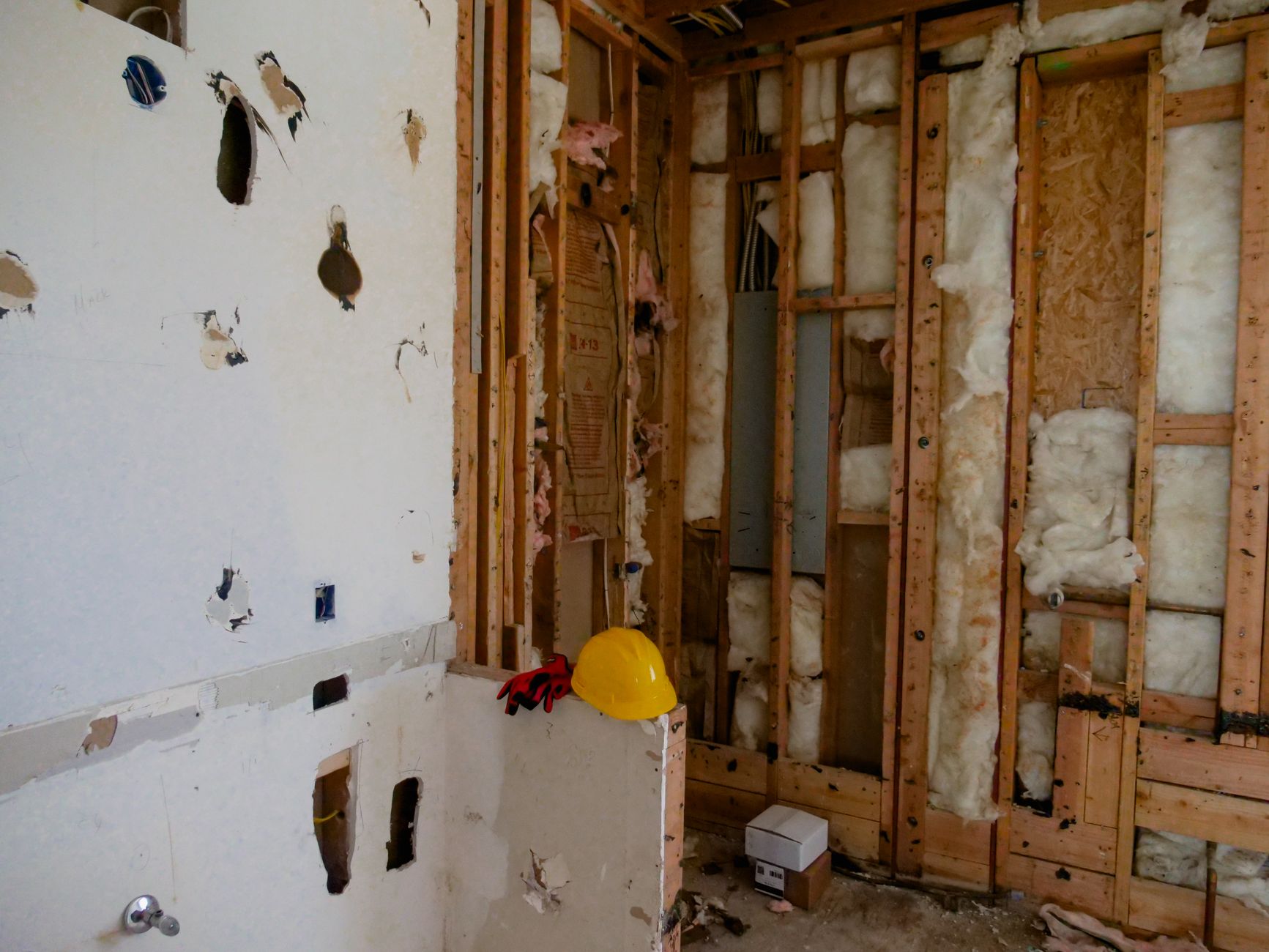
The hardest part of any completion dispute is the part now sitting behind finished surfaces. Insulation, blocking, rough plumbing, cable runs, the membrane under the tile. Once it is closed, inspecting it means opening it, and opening it costs money somebody has to agree to spend before anyone knows who was right.
Building codes treat this as a scheduling problem rather than a question of trust. Section R109.1.2 of the International Residential Code, carried into state codes as the plumbing, mechanical, gas and electrical systems inspection, puts the rough inspection of those systems prior to covering or concealment, before fixtures or appliances are set, and ahead of the framing inspection. Inspectors are not sent because the trades are under suspicion. They are sent because by Friday the wall exists and nobody can see through it.
Your own file runs on the same deadline with nobody enforcing it. If a stage closes Thursday, the photograph of that stage either exists by Wednesday or it never will. Which is why “we take photos” is not a documentation policy. Photographs taken when somebody happens to remember are a reliable record of when people remember things.
Move one field off the crew’s phone
None of this asks the trades to work differently. No extra equipment, no download, no account to set up. What relocates is one field of the record, and it is a small one: the clock.
A text reaches the phone already in a pocket on site. Tapping it brings up the live viewfinder, with no roll to browse and no file picker, so an old shot of a finished bathroom has no route into this record. On submit, our server takes the image and notes its own arrival time, since a clock inside a handset answers to whoever is carrying the handset. Where the worker shares location, that reading is stored beside it, and on jobs that warrant it you can insist on a reading before anything is accepted. Image, server time, any coordinates present, and the storage path are then hashed together with SHA-256, so any later change breaks the match. Tamper-evident is a claim about detection rather than impossibility. Someone can still edit that record. They cannot do it quietly.
On dispatched work, the record exists ahead of the crew. Your account issues the job, the server is already holding an entry for that send before anybody taps a link, and the photo is written straight back into it. What you finish with, then, is not a picture somebody decided to take. It is a picture that arrived inside a job you had already opened. Undispatched work is handled separately: a standing per-worker link lets a trade record the same sort of capture with nobody asking, and those records stay marked as employee-initiated, so a Saturday callback never gets mistaken for a scheduled visit.
| At the walkthrough | Sealed on arrival | Email, texts, a sheet |
|---|---|---|
| Who put the date on it | Our server, on arrival | The handset that sent it |
| Whether this is even the right room | Only the live viewfinder feeds it | Any stored file can be attached |
| Whether the stage was shot before closing | The scheduled send asks for it | If anyone thought of it |
| Whether the file moved since | The hash no longer agrees | No baseline to check against |
The contractor wants this file too
All of the above reads like a buyer’s problem, and half of it is. The other half sits with the trade who did the work properly and is now being told otherwise. They lose that argument for exactly the same structural reason the owner loses the first one: the only surviving account of Tuesday is theirs, and they are the ones asking to be paid.
So the version that works is not a private folder on either side. When a capture lands somewhere the owner can open, one photograph does two jobs months apart. A LockProof record travels as a URL any browser will render without a sign-in, short-lived on purpose: seven days, then it stops resolving. Minting a replacement is quick, and neither link alters the record underneath. There is a finished example at our sample proof record, and the wider habit is the subject of dispute-ready vendor records, whichever trade you are hiring.
What a sealed capture settles, and what it leaves alone
Keep the claim small, because overselling it is how you lose a contractor who was doing fine work. Two facts survive and no others. The picture was made through a lens while somebody stood there, rather than pulled from a folder afterwards, and the record reads today exactly as it read the day it was sealed.
Scene truth is not among them. Whether the tile met spec, whether the wire behind that plate is the right gauge, whether the second coat really went on: those remain judgements about construction, and they belong to people who understand construction. The shift is smaller than that, and better aimed. Ask whether the rough-in was finished before the wall closed, and there is now an artifact to weigh beside the answer instead of the answer by itself. Property managers putting the same question to repair vendors will recognise it from when a tenant claims the repair was not completed, and the trade-by-trade version lives on LockProof for field service.
Common questions
My contractor says the work is done but it is not. What now?
Walk the site against the contract line items rather than your impression, and photograph each missing item beside the line claiming it was finished. Separate scope that was never performed from scope performed badly, because they are checked differently. Then put the remaining work in writing in terms both sides can walk and agree on.
How do you show a contractor did not finish what was paid for?
With records made while the work was still reachable, and dated by something other than the handset that took the picture. One photograph per stage, mapped to the scope line it belongs to. Once a stage is closed up, checking it turns into demolition, which is slow and costs money somebody has to approve.
How do you prove work was done before it was covered up?
Photograph it on the day, ahead of the drywall, rather than from memory afterwards. The residential building code sets that same deadline for inspectors: rough plumbing, mechanical, gas and electrical work is inspected prior to covering. A capture sealed with a server-set time carries that stage past the wall.
Are the contractor’s own photos good enough?
They help, and settle less than people expect. The date buried inside a photo file is an editable value owned by whoever holds the file. What makes a picture useful in a disagreement is the part the sender did not author: a live camera with no gallery to choose from, and a time a server writes on submission.
How do you verify subcontractor work you never watched?
Ask each trade for a capture per stage instead of a report at the end. Every one arrives as a live photo against a job you scheduled, timed by our server as it lands, and carrying the worker’s own location reading whenever they share one. A general contractor then reviews records rather than ten accounts of the same week.